
This post will focus specifically on examples of IEPs and their connections to assistive technology. The IEPs were taken from the Wisconsin Assistive Technology Initiative. My purpose in sharing these IEPs with you is to help you become familiar with different types of assistive technology devices and how those devices can help different students needs and annual goals.
1. Eric
Present Levels: Eric participates in
regular education programs for his academic subjects. His hand strength is
limited and he fatigues quickly when doing any handwriting task. Civics and
English homework are a particular problem because of lengthy assignments and
reports that need to be completed.Annual Goals: Eric will use a computer or portable word processor to complete 100% of his assignments in 10th grade English and Civics classes.
Assistive Technology:
 |
| Alphasmart, portable word processor |
2. Becky:
Present Levels: Becky is learning to read and is anxious to complete writing assignments with her peers. She is not able to produce handwritten material due to severe spastic quadriplegia. Becky is interested in using the computer and has been introduced to it. The staff has helped Becky experiment with several switches in a variety of locations. She seems to be most accurate using a switch mounted next to her head.
Annual Goals: Becky will use a single switch mounted on a switch-mounting arm positioned to the right side of her head and scanning software to access the computer 9 out of 10 times for a variety of educational assignments.
Assistive Technology:
 |
| Single switch & mounting arm |
3. Mary:
Present Levels: Mary currently communicates with sounds that are not always understood by those around her. She often becomes upset when she is not understood. She likes people and likes to be around both adults and children. She is beginning to play simple games.
Annual Goals: Mary will communicate her interests and needs in three or more environments/situations using a single message voice output device.
Assistive Technology:
 |
| Single message voice output device |
4. Kelly:
Present Levels: Kelly is in the third grade classroom for most of his day. He has a full time paraprofessional who assists him. He is unable to use a standard keyboard because of his physical limitations. Additionally, his speech is frequently unintelligible. He currently uses single message and multiple message voice output devices, eye gaze, and limited direct selection to complete his academic work. Kelly is functioning at about the second grade level in most curricular areas.
Annual Goals: Kelly will use an adapted keyboard with custom overlays and a computer with talking word processing to complete all academic work.
Assistive Technology:
 |
| Adapted keyboard with custom overlays |
5. Stephen:
Present Levels: Steven is a four-year-old boy diagnosed with pervasive developmental disorder. His placement is in an Early Childhood classroom. He is able to understand and comprehend when spoken to, but does not communicate his needs consistently. When choices are simplified and broken into steps, Steven will try to communicate wants and needs. Peer interactions are limited.
Annual Goals: Steven will use a picture board or voice output device to express wants and needs to adults and peers in both home and school at least four times each day.
Assistive Technology:
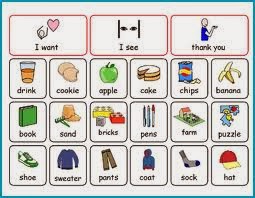 |
| Picture Board |
Wisconsin Assistive Technology Initiative. (2013, 07 12). Wisconsin Assistive Technology Initiative. Retrieved from: http://www.wati.org/.

No comments:
Post a Comment